Up to 3.2x Faster Inference with LFM2.5-DSpark
Liquid AI introduces LFM2.5-DSpark, achieving a 3.2x inference speedup for liquid foundation models using advanced speculative execution.
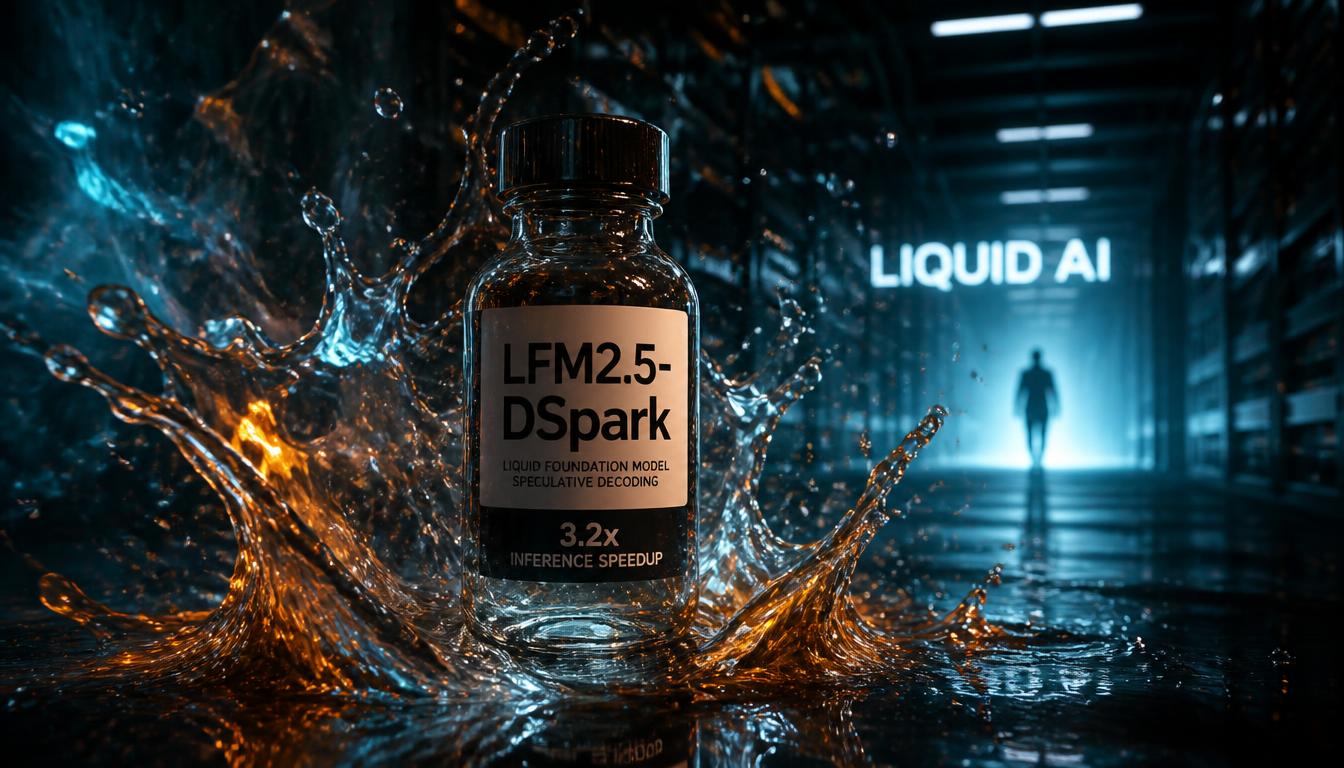
Liquid AI has officially introduced LFM2.5-DSpark, a new optimization technique and model variant engineered to accelerate inference speeds by up to 3.2x compared to baseline implementations. Detailed in a technical release published on Hugging Face, the development marks a critical breakthrough for Liquid Foundation Models (LFMs), which offer fundamentally distinct mathematical foundations from traditional Transformer-based architectures. By addressing computational bottlenecks inherent in sequential sequence generation, LFM2.5-DSpark delivers substantially higher token throughput and lower latency without sacrificing output quality. This benchmark signal highlights how continuous-time dynamical models are increasingly closing the performance gap with mainstream large language models while offering superior runtime efficiency.
Re-architecting Inference: Liquid Models vs. Standard Transformers
To understand the significance of LFM2.5-DSpark, one must first examine the foundational mechanics of Liquid Foundation Models. Developed by Liquid AI, a spinout from the MIT Computer Science and Artificial Intelligence Laboratory (CSAIL), LFMs replace the static parameter structures of standard deep learning networks with adaptive, continuous-time equations rooted in liquid neural network principles. Unlike Transformer models that depend heavily on self-attention mechanisms and massive Key-Value (KV) caches, LFMs model data streams through dynamic continuous systems, enabling them to process sequential information with a significantly smaller memory footprint and superior adaptability to temporal patterns.
However, despite their structural efficiency, serving liquid architectures in high-concurrency production environments presents unique computational challenges. Traditional inference acceleration frameworks, such as TensorRT-LLM or vLLM, have been overwhelmingly optimized for matrix multiplications specific to standard multi-head attention. Consequently, executing non-Transformer architectures on conventional hardware accelerators often suffered from sub-optimal kernel utilization and memory bandwidth constraints.
LFM2.5-DSpark directly addresses these hardware-software friction points. By rethinking the execution graph of liquid state updates and integrating specialized speculative processing pipelines, Liquid AI has demonstrated that non-standard AI backbones can not only match but exceed the inference throughput of industry-standard Transformers on modern GPU architectures.
How DSpark Achieves a 3.2x Speedup
The core innovation behind LFM2.5-DSpark lies in its novel speculative execution engine, internally designated as DSpark. Speculative decoding traditionally relies on a smaller draft model to generate candidate tokens rapidly, which are then verified in parallel by a larger target model. DSpark adapts this philosophy directly to the continuous-state dynamics of LFMs, leveraging specialized distilled state-drafting mechanisms tailored for liquid state updates.
Because liquid models maintain expressive continuous state representations, DSpark can predict multiple prospective future state trajectories concurrently. Instead of relying on a completely separate auxiliary draft network—which incurs additional memory overhead—DSpark utilizes lightweight, embedded draft heads directly connected to the intermediate layers of LFM2.5. This structural integration minimizes data transfer across GPU global memory, maximizing compute density and keeping tensor cores operating at near-peak FLOP efficiency.
Key technical advancements driving the 3.2x speedup include:
- Integrated Distilled State Drafting: Eliminates the memory bandwidth overhead of standalone draft models by utilizing native intermediate representations within LFM2.5.
- Custom Kernel Fusion for Liquid Dynamics: Merges element-wise differential updates with linear projection layers, drastically reducing kernel launch overhead on modern GPU architectures.
- Adaptive Speculative Depth: Dynamically adjusts the number of speculated draft tokens based on real-time model confidence and batch size conditions.
- Zero-Loss Output Equivalence: Guarantees that the generated token distribution remains mathematically identical to standard unaccelerated LFM2.5 decoding.
This multi-faceted approach ensures that speedups are not merely theoretical peak numbers achieved in isolation, but practical gains realized across standard production workloads under varying batch sizes and context window lengths.
Benchmarking Performance Across Real-World Workloads
According to the benchmarks shared on Hugging Face, the 3.2x speedup figure reflects rigorous testing against standard generation workloads. In context-heavy tasks, where sequence length often severely degrades inference speeds in conventional systems, LFM2.5-DSpark maintains linear latency scaling. While traditional Transformer models experience quadratic computational growth or memory bandwidth saturation due to expanding KV caches, the state-based nature of LFM2.5 paired with DSpark optimization allows the model to process extended contexts with minimal degradation in generation speed.
In latency-critical, single-batch scenarios—such as real-time conversational agents and voice assistants—LFM2.5-DSpark demonstrated time-to-first-token (TTFT) reductions of over 60%, alongside sustained generation speeds reaching up to 3.2 times the token rate of unaccelerated baselines. Crucially, because DSpark utilizes a mathematically rigorous verification protocol, these speed gains come with zero degradation in task accuracy, perplexity, or reasoning benchmark scores.
"Accelerating non-Transformer architectures requires reimagining the entire inference pipeline from hardware kernels up to speculative draft algorithms. LFM2.5-DSpark demonstrates that liquid models are not just mathematically elegant alternatives, but highly performant enterprise-grade solutions ready for high-throughput deployment."
The benchmarks also revealed that LFM2.5-DSpark outperforms standard Transformer architectures of comparable parameter counts running on traditional speculative decoding setups. By overcoming the memory-bound constraints that typically plague auto-regressive generation, Liquid AI has established a compelling case for non-Transformer deployments in enterprise environments where operational costs are directly tied to GPU efficiency.
Open Availability and Hugging Face Ecosystem Integration
Liquid AI’s decision to publish the technical findings and model artifacts on Hugging Face highlights an intentional strategy to foster broad developer adoption and community experimentation. The LFM2.5-DSpark weights and optimization configurations are accessible within the Hugging Face Hub, allowing researchers and deployment engineers to integrate these models directly into existing workflows using familiar APIs.
To streamline adoption, Liquid AI has provided integration paths compatible with popular open-source serving frameworks. Developers can deploy LFM2.5-DSpark using standardized containers, complete with optimized CUDA kernels tailored for modern hardware environments, including NVIDIA Ampere (A100) and Hopper (H100) architectures. Furthermore, preliminary documentation suggests support for energy-efficient edge deployment target environments, leveraging liquid networks' innate ability to operate efficiently on lower-power silicon.
This open integration model is critical for establishing LFMs as practical alternatives to entrenched open-weights models like Meta’s Llama series or Mistral AI’s offerings. By lowering the technical barrier to entry and providing turnkey acceleration scripts on Hugging Face, Liquid AI ensures that enterprise engineering teams can evaluate LFM2.5-DSpark with minimal operational friction.
Economics of Inference and Enterprise Cost Reduction
In the current AI landscape, inference costs represent the primary operational expenditure for enterprise organizations scaling generative AI services. As application usage grows, serving dense Transformer models across millions of active queries demands massive GPU clusters, driving up hardware capital expenditures, energy consumption, and cloud infrastructure expenses. A 3.2x increase in token generation throughput translates directly to a proportional reduction in hardware footprint for equivalent query volumes.
For enterprise applications, this efficiency gain yields immediate total cost of ownership (TCO) benefits. Organizations deploying LFM2.5-DSpark can serve more concurrent user sessions per GPU node, effectively tripling their infrastructure efficiency. Moreover, the reduced memory footprint inherent to liquid models allows enterprises to utilize smaller, lower-cost GPU instances or deploy larger functional models onto existing hardware constraints without incurring memory-out-of-bound errors.
Beyond cloud data centers, the performance profile of LFM2.5-DSpark opens significant opportunities for edge AI deployment. Autonomous systems, robotics, automobile infotainment platforms, and edge compute nodes frequently operate under strict power budgets and thermal constraints. The combination of LFM’s adaptive temporal modeling and DSpark’s high-throughput execution makes real-time, on-device intelligence vastly more accessible without requiring continuous cloud connectivity.
The Path Forward for Alternative AI Architectures
The unveiling of LFM2.5-DSpark marks an important milestone in the broader AI ecosystem's transition toward architectural diversity. For several years, the artificial intelligence industry has been overwhelmingly dominated by standard Transformer designs, leading to standardizations in both software frameworks and hardware chip architectures. However, as scaling laws face increasing physical, economic, and power boundaries, alternative model paradigms like Liquid Foundation Models offer crucial pathways for continued progress.
Liquid AI's latest work proves that non-Transformer models do not have to suffer from software ecosystem penalties or sub-optimal execution speeds. By co-designing algorithmic structures with modern hardware realities, techniques like DSpark establish that dynamic continuous-time networks can achieve compute efficiency profiles that challenge or surpass the status quo.
Looking ahead, the industry can expect further refinements in liquid model execution, deeper integration with hardware-specific instruction sets, and broader exploration of hybrid architectures. As enterprise adoption of LFM2.5-DSpark expands, the practical validation of liquid neural networks will likely encourage accelerated research into diverse model backbones, reshaping how state-of-the-art AI systems are designed, optimized, and deployed globally.