From Raw Audio to Actionable Data, Automating Call Center Triage with Cortex AI
Learn how enterprise call centers leverage Cortex AI to convert unstructured voice logs into actionable data and automated triage workflows.
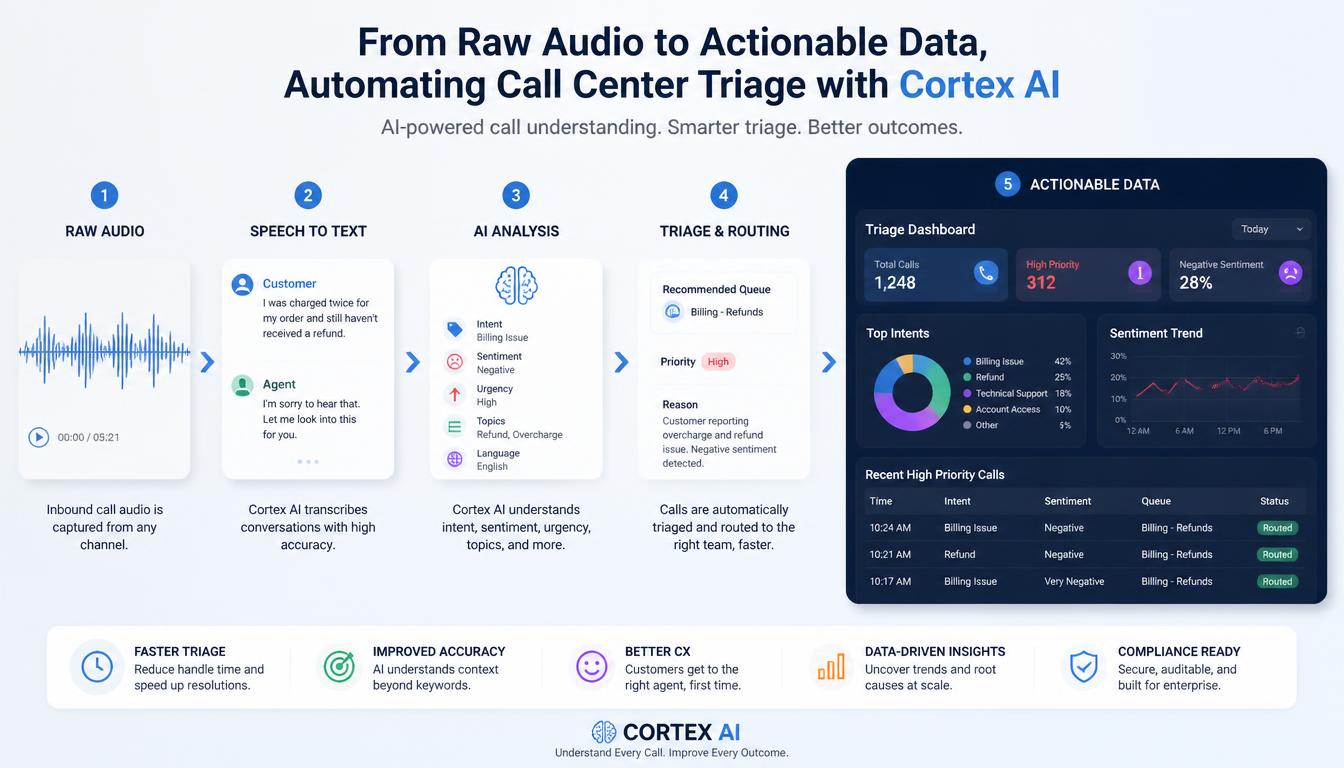
Call centers generate thousands of hours of raw audio data daily, yet the overwhelming majority of this valuable enterprise data remains locked inside unstructured voice files and messy transcripts. Traditional customer support operations rely on manual triage and post-call logging, leading to inflated average handle times, inconsistent agent performance, and delayed escalations for critical customer issues. The integration of Cortex AI into customer service architectures introduces a transformative approach, converting unstructured audio logs into real-time actionable intelligence and automated routing workflows. By bridging advanced automatic speech recognition with large language model orchestration, enterprises are fundamentally altering how contact center triage operates at scale.
The Infrastructure Bottleneck in Modern Contact Centers
Contact centers have long operated under the weight of information asymmetry and legacy software constraints. When a customer dials into a support line, the call is recorded, compressed, and archived in cold storage repositories, rarely analyzed beyond periodic manual quality assurance audits. Frontline agents are forced to split their cognitive focus between listening to distressed callers, searching knowledge repositories, and manually logging case notes into CRM software. This operational model creates severe bottlenecks, where human error and cognitive overload lead to inaccurate routing, missed cross-sell opportunities, and unaddressed compliance violations.
Furthermore, standard speech-to-text (STT) solutions introduced over the past decade often fell short of enterprise expectations. Legacy transcription services produced block text without speaker diarization, contextual formatting, or semantic understanding, leaving operations managers with vast text files that required additional manual review. As call volumes surged across telecommunications, financial services, healthcare, and retail sectors, the friction of manually triaging every incoming voice interaction became unsustainable. Modern organizations require an end-to-end processing pipeline that not only transcribes spoken dialogue but immediately interprets caller intent, urgency, and underlying sentiment.
The financial consequences of unoptimized voice operations are substantial. Prolonged hold times directly correlate with reduced Customer Satisfaction (CSAT) scores and heightened churn rates. Moreover, high post-call wrap-up times (ACW) reduce agent utilization rates, forcing enterprises to continually expand workforce counts without achieving proportional gains in resolution quality. Automating the ingestion and triage phase of this workflow represents one of the highest-ROI deployment areas for applied artificial intelligence in the modern enterprise landscape.
Architecture of Cortex AI Audio Triage Pipelines
Implementing Cortex AI within a call center ecosystem involves a multi-stage data orchestration pipeline designed to turn continuous voice streams into structured data tables and real-time triggers. The pipeline begins at the media ingestion layer, where incoming call streams are captured via VoIP protocols or retrieved from cloud storage buckets immediately following call termination. Advanced automatic speech recognition (ASR) engines, optimized with domain-specific vocabularies and multi-speaker diarization capabilities, convert the raw acoustic waveforms into high-fidelity, time-stamped text scripts.
Once raw transcription is established, Cortex AI leverages modern large language models and vector search capabilities to perform semantic analysis on the text stream. Rather than relying on simple keyword matching, Cortex AI analyzes context, acoustic tone indicators, and conversational cadence to evaluate caller intent. The framework structures the conversational output into pre-defined JSON schemas, assigning metadata such as caller sentiment scores, primary issue classification, root cause analysis, and recommended escalation priority.
Key components of an enterprise Cortex AI voice pipeline typically include:
- High-precision Automatic Speech Recognition (ASR) with multi-speaker diarization and acoustic noise suppression.
- Dynamic text normalization to format spoken entities, dates, dollar amounts, and account numbers into standardized data structures.
- Intent classification models powered by fine-tuned LLMs inside Cortex AI to identify primary root causes and ticket categories.
- Sentiment and urgency evaluation algorithms that scan for escalation indicators, policy non-compliance, or heightened caller frustration.
- Automated API orchestration layers that push structured payloads into CRM, ticketing, and enterprise resource planning systems in real time.
By consolidating these modules into a single managed environment, Cortex AI minimizes latency between the moment a call ends and the point at which actionable data becomes available across the enterprise tech stack.
Converting Raw Audio to Actionable Data and Workflow Triggers
The true breakthrough of automated triage lies in its ability to convert unstructured conversational chaos into structured databases that trigger downstream operational workflows. When Cortex AI processes a call transcript, it generates structured metadata fields that map directly to enterprise business rules. For instance, if a caller expresses frustration regarding a billing discrepancy on a premium account, the system instantly generates an urgent priority tag, extracts the disputed monetary amount, and assigns the case to a specialized billing retention queue before human supervisors even open the ticket.
This automated extraction capability extends beyond triage into proactive compliance management and risk mitigation. In regulated sectors such as banking, insurance, and healthcare, agents must adhere to strict verbal disclosure protocols. Cortex AI continuously evaluates incoming transcripts against regulatory compliance checklists, identifying missing disclosures or improper verification steps. Should a critical compliance failure occur, the system can automatically flag the interaction for immediate supervisor audit and send automated remediation steps to the agent's dashboard.
blockquote>"Automating call center triage isn't merely about faster transcription; it's about translating human speech into structured corporate intelligence that drives immediate operational decisions and proactive customer care."Additionally, the system feeds aggregated metadata back into enterprise data warehouses, allowing product management and operations teams to perform macro-level trend analysis. Instead of relying on anecdotal feedback from support teams, leadership can query natural language insights from thousands of call logs simultaneously. This yields instant visibility into emerging product defects, confusing billing updates, or geographic service outages based on real-time spikes in customer call topics.
Quantifiable Operational Gains and Agent Empowerment
The deployment of Cortex AI for audio triage provides measurable operational improvements across several key contact center performance metrics. By offloading post-call wrap-up activities to automated AI pipelines, organizations experience a drastic reduction in Average Handle Time (AHT) and After-Call Work (ACW). Agents no longer need to manually write detailed summary notes or select drop-down categories in CRM tools; Cortex AI auto-populates comprehensive, bulleted summaries and categorizations in real time, saving up to two to three minutes per interaction.
Furthermore, automated triage significantly enhances First Contact Resolution (FCR) rates by ensuring that calls and tickets are routed to the most qualified agents on the initial attempt. In legacy setups, mistriaged calls often underwent multiple internal transfers before reaching the appropriate subject matter expert, increasing customer frustration and operational overhead. Intelligent routing based on Cortex AI's precise initial analysis ensures that specialized inquiries immediately reach agents equipped with the exact knowledge articles and system permissions required to resolve the issue.
Human-in-the-loop (HITL) design patterns ensure that AI automation complements human judgment rather than replacing it unthinkingly. Agents receive pre-triaged case files accompanied by AI-suggested resolution pathways, confidence scores, and quick-link reference documentation. Frontline staff retain full authority to adjust AI classifications or edit generated summaries, providing a continuous feedback loop that progressively fine-tunes the underlying Cortex AI models over time.
Looking Ahead: The Evolution of Intelligent Voice Operations
As artificial intelligence models become increasingly multimodal and context-aware, the boundary between post-call processing and live-call interaction is rapidly dissolving. Future iterations of Cortex AI architectures will operate with ultra-low latency, enabling real-time voice triage that assists agents during the call itself rather than exclusively after the hang-up. Real-time sentiment monitoring will prompt live coaching tips, alert team leads to escalating situations mid-conversation, and dynamically surface relevant knowledge articles based on ongoing speech streams.
The transition from reactive call logging to proactive intelligence marks a pivotal milestone in enterprise digital transformation. Companies that adopt automated audio triage with systems like Cortex AI position themselves to transform high-cost, high-friction contact centers into strategic data hubs. By extracting structured value from every spoken customer interaction, organizations can continuously refine product strategy, streamline service delivery, and raise the bar for modern customer experience standards.