The Download: AI’s self-improvement problem, and what’s driving the heat
Exploring the technical barriers to recursive AI self-learning alongside the physical heat and energy footprint of global data centers.
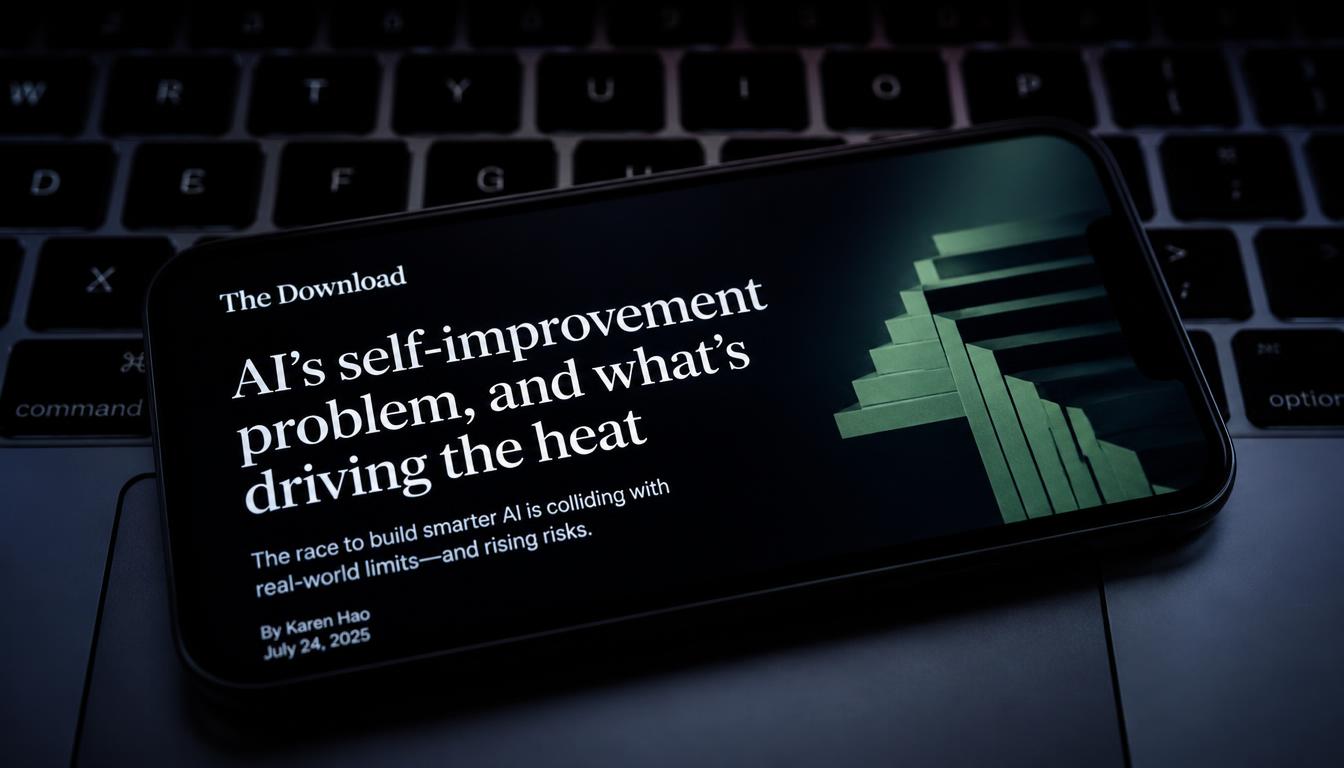
MIT Technology Review's latest edition of "The Download" spotlights two critical challenges shaping the future of artificial intelligence: the technical hurdles of recursive self-improvement and the mounting environmental costs associated with data center energy usage.
As AI developers aim to create systems that autonomously improve themselves, overcoming algorithmic degradation and physical compute constraints has become essential for the next phase of progress. These dual issues underline the friction between theoretical AI capabilities and real-world resource limitations.
The Barrier to Recursive Self-Improvement
Recursive self-improvement—the concept of an AI system iteratively training and refining its successors—faces persistent theoretical and practical bottlenecks. Researchers frequently cite risks like "model collapse," where models trained on synthetic data generated by previous iterations suffer from decaying output quality and amplified bias over time.
Without robust feedback mechanisms and novel validation techniques, self-improving models risk compounding errors rather than expanding intelligence.
While self-rewarding language models and advanced reasoning loops offer promising avenues, achieving reliable, autonomous self-improvement without human-curated data remains a major unresolved challenge in frontier AI research.
Computational Infrastructure and Thermal Pressures
Alongside these algorithmic barriers lies a growing physical crisis: the intense heat and energy demands generated by AI infrastructure. As training clusters scale to hundreds of thousands of high-performance chips, power consumption and thermal output have surged, taxing local electrical grids and cooling systems.
Addressing these intersecting challenges will require dual breakthroughs—both in sample-efficient model architectures that can learn without degrading, and in sustainable energy solutions capable of supporting global AI deployment.