Strengthening democratic oversight in national security
OpenAI details new governance mechanisms to ensure frontier AI applications in national security remain aligned with democratic values and oversight.
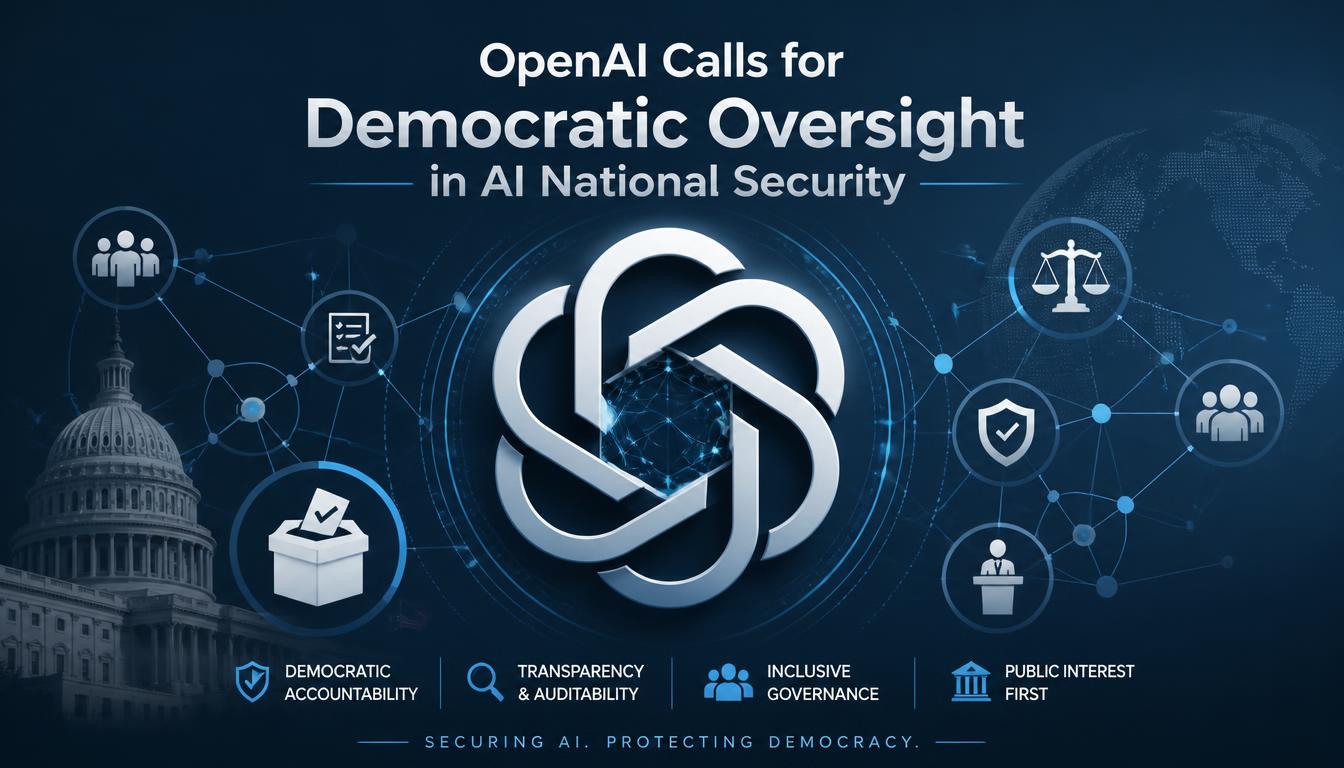
As artificial intelligence systems become increasingly central to statecraft, defense infrastructure, and national intelligence operations, the question of how to govern these technologies without compromising democratic values has reached a critical juncture. OpenAI has published a comprehensive framework addressing the imperative for robust democratic oversight in national security deployments of frontier AI models. The policy initiative outlines structural mechanisms designed to align high-stakes defense applications with public accountability, legislative checks, and international human rights standards. As nation-states accelerate their integration of generative and autonomous tools into defense workflows, OpenAI's announcement represents a pivotal effort to establish operational guardrails for dual-use technology.
The Evolving Frontier of AI in Defense and Intelligence
The intersection of advanced artificial intelligence and national security has rapidly transitioned from theoretical policy debates into operational reality. Intelligence agencies and defense departments worldwide are deploying large language models, computer vision systems, and automated predictive tools to analyze vast datasets, streamline strategic logistics, and enhance situational awareness. However, the unique capabilities of frontier models present unprecedented governance challenges that traditional defense procurement models were not designed to address.
Historically, tech companies maintained rigid boundaries or outright prohibitions regarding the use of their commercial tools for military purposes. Over recent years, as the dual-use nature of advanced software became clear, key industry leaders recognized that total disengagement could leave democratic states at a technological disadvantage compared to authoritarian regimes actively deploying AI without public oversight. Consequently, the focus has shifted from prohibiting involvement to defining strict, ethically bound conditions under which technology providers can collaborate with national security institutions.
This structural shift requires redefining how sovereign power, corporate responsibility, and democratic mandates interact. OpenAI's latest position emphasizes that while defending open societies requires cutting-edge technical capabilities, those capabilities must never operate in a vacuum devoid of constitutional principles, judicial review, or legislative accountability.
Core Pillars of OpenAI's Oversight Framework
To operationalize democratic accountability within complex national security environments, OpenAI's framework establishes several structural pillars aimed at maintaining institutional checks and technical safeguard visibility. These pillars bridge the gap between abstract ethical commitments and practical deployment conditions, ensuring that security agencies operate within clearly defined statutory boundaries.
The proposed architecture focuses on multi-layered verification, combining technical evaluation with institutional reporting to prevent unauthorized mission creep or covert misuse. By establishing clear thresholds for system deployment, the framework seeks to ensure that human operators remain legally and operationally accountable for AI-assisted decisions.
- Civilian Authorization and Oversight: Ensuring that all defense deployments of AI tools are mandated by elected officials and subject to ongoing legislative supervision.
- Rigorous Red-Teaming and Safety Testing: Implementing specialized threat evaluations tailored to military and intelligence contexts prior to system deployment.
- Human-in-the-Loop Safeguards: Mandating meaningful human control over critical decisions, particularly those involving kinetic actions or high-stakes intelligence assessments.
- Interoperability with Human Rights Standards: Enforcing strict adherence to international humanitarian law and constitutional civil liberties protections across all operational implementations.
- Auditability and Logging: Maintaining immutable logs of AI decisions and data flows to facilitate post-hoc investigation and democratic auditing.
These mechanisms aim to create a verifiable chain of responsibility. By mandating technical audit trails alongside statutory reporting, the framework provides democratic bodies with the visibility required to evaluate whether defense applications adhere to established legal guidelines.
Navigating Dual-Use Capabilities and Autonomous Systems
One of the most complex dimensions of modern national security governance involves managing dual-use technologies—systems capable of both beneficial civilian applications and potent offensive military uses. Frontier large language models can assist in vulnerability research to patch critical infrastructure, but the exact same underlying capabilities could theoretically be harnessed to develop novel cyber-attacks or automate intelligence operations at scale.
To mitigate these risks, OpenAI advocates for granular, domain-specific threat modeling that evaluates the risk profile of software before deployment in sensitive environments. Rather than relying on blanket classification rules, the framework emphasizes continuous risk assessment tailored to the specific operational deployment scenario.
"Democratic oversight of artificial intelligence in national security must ensure that advanced technology serves to reinforce constitutional rights and civilian control, rather than eroding the foundational checks and balances of open societies."
Furthermore, the position paper addresses the growing concern surrounding autonomous decision-making in defense applications. OpenAI reiterates that AI models should serve as decision-support systems rather than fully autonomous agents in critical security contexts, keeping human judgment, ethical deliberation, and legal accountability firmly at the core of national defense workflows.
Inter-Agency Collaboration and Global Democratic Alliances
National security governance does not stop at national borders; it requires deep coordination among international allies committed to maintaining a rules-based order. OpenAI's document underscores the importance of fostering collaborative alignment among democratic nations, such as NATO members and Five Eyes partners, to establish shared standards for ethical AI deployment in security operations.
By establishing unified operational standards among democratic allies, international coalitions can counter the proliferation of state-sponsored digital authoritarianism. Authoritarian regimes are increasingly leveraging AI for pervasive domestic surveillance, automated social control, and asymmetric warfare. Establishing a clear, ethically grounded alternative demonstrates that state security can be bolstered without sacrificing fundamental democratic principles.
This global perspective extends to standardizing terminology, evaluation benchmarks, and cross-border data governance protocols. As allied defense forces increasingly share intelligence and coordinate joint operations, standardized AI safety norms become vital to ensuring system interoperability and shared legal compliance.
Public Transparency versus Operational Secrecy
A perennial tension in national security policy is the friction between public transparency and legitimate operational secrecy. While defense agencies necessarily require confidentiality to protect ongoing operations and intelligence sources, democratic systems depend on public visibility to maintain the consent of the governed.
OpenAI proposes addressing this tension through structured disclosure mechanisms. These include generating unclassified executive summaries of AI safety evaluations, providing specialized cleared briefings to bipartisan legislative committees, and engaging independent third-party experts to audit compliance without exposing sensitive intelligence operational details.
Such mechanisms ensure that secrecy is restricted to genuine operational parameters rather than used as a shield against public accountability. By opening technical methodologies to independent oversight, AI developers and government partners can build public trust while safeguarding national security information.
Building a Governance Blueprint for the Era of Autonomous Defense
As artificial intelligence continues to reshape global defense postures, establishing clear, actionable governance models is no longer optional—it is a strategic necessity. OpenAI's commitment to strengthening democratic oversight sets a significant benchmark for how frontier AI developers and government stakeholders must navigate the intersection of technical capability, national defense, and civil liberties.
Looking forward, the success of these proposals will depend on continuous iteration between policy makers, technical researchers, and civil society advocates. As national security tools become more sophisticated, governance frameworks must evolve dynamically to address novel risk vectors while upholding democratic norms.
Ultimately, the objective is to ensure that as AI reshapes the security landscape, democratic institutions retain their supervisory role. By embedding civilian authority, transparent auditing, and human accountability into defense AI integrations, the industry can support national defense while upholding the core principles of free and open societies.