Replit expands access to software creation with GPT-5.6 Luna
Replit has integrated OpenAI's GPT-5.6 Luna, unlocking autonomous, lightning-fast software development capabilities for creators worldwide.
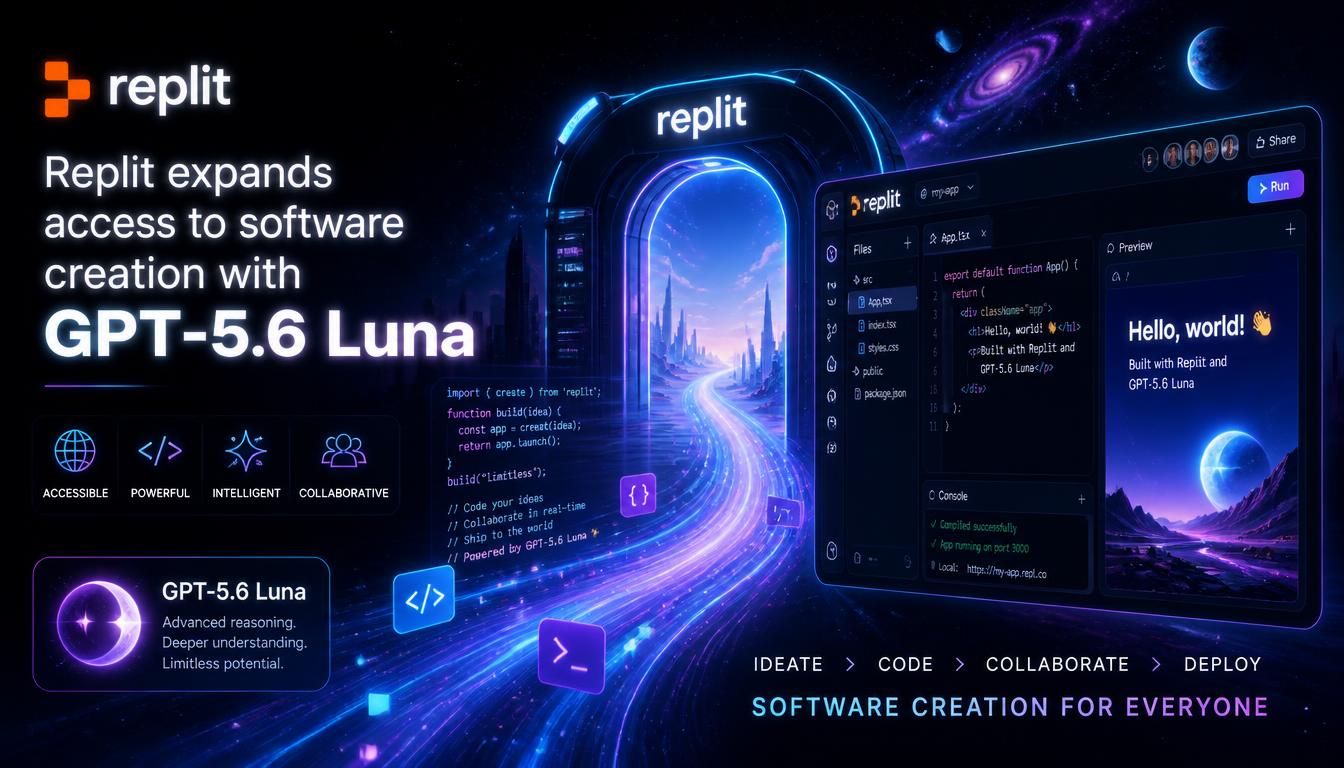
Replit has announced a landmark expansion of its software creation platform through an integration with OpenAI's newly revealed GPT-5.6 Luna model. This strategic move brings sophisticated agentic coding, ultra-fast inference speeds, and end-to-end application blueprinting directly into Replit's cloud-native development environment. By joining Replit's autonomous deployment infrastructure with the advanced reasoning capabilities of GPT-5.6 Luna, the two companies aim to dramatically lower the barrier to software engineering for non-technical users while radically augmenting the productivity of seasoned developers. The release signifies a major milestone in the evolution of artificial intelligence as a primary driver of software production.
Redefining Developer Workflows with GPT-5.6 Luna
The evolution of AI-assisted coding has transitioned rapidly from basic line-completion tools to autonomous agents capable of navigating entire codebases. Replit, which pioneered cloud-based collaborative coding environments, has spent recent years refining its agentic infrastructure to allow users to build complete web and mobile applications through plain natural language instructions. The addition of GPT-5.6 Luna represents the engine room of this transformation, providing the underlying intelligence required to parse complex user intent, generate clean code architectures, and manage dependencies without human intervention.
OpenAI's GPT-5.6 Luna is specifically architected for low-latency, high-throughput technical tasks. Built on a modular foundation that prioritizes structural logic and algorithmic precision, Luna minimizes the latency traditionally associated with deep reasoning models. When embedded inside Replit, this enables near-instantaneous feedback loops during software construction. Developers and non-technical founders can issue high-level instructions—such as creating an e-commerce backend with database integration and authentication—and watch as Luna systematically constructs the files, installs packages, and provisions cloud infrastructure in real time.
What distinguishes this partnership is the tight alignment between model output and platform execution. Previous iterations of AI coding required developers to copy and paste generated snippets, debug syntax errors manually, or troubleshoot environment configuration mismatches. Under the GPT-5.6 Luna integration, Replit acts as a sandboxed execution layer where the AI model can directly execute shell commands, run test suites, interpret terminal error outputs, and self-correct code in a closed-loop feedback system.
Core Architectural Capabilities and Performance Highlights
GPT-5.6 Luna introduces several key architectural breakthroughs designed to handle the multi-layered complexities of modern software stacks. Chief among these is its enhanced context management system, which allows the model to maintain state awareness across hundreds of individual code files, database schemas, and external API configurations simultaneously. Rather than treating code generation as isolated text predictions, Luna approaches software as an interconnected system, ensuring that changes made to a backend service instantly propagate across frontend components and database migrations.
Furthermore, the model excels at cross-language interoperability and full-stack synthesis. Whether orchestrating a React interface with a Python FastAPI backend or configuring Docker containers alongside SQL relational databases, Luna handles syntax and framework conventions with remarkably low error rates. The model’s fine-tuned understanding of modern software design patterns allows it to auto-generate modular, readable, and scalable code that adheres to strict industry standards.
Key features enabled by the GPT-5.6 Luna integration inside Replit include:
- Autonomous Multi-File Refactoring: Ability to modify code across complex file trees while preserving dependency graphs and type safety.
- Self-Healing Code Execution: Automatic detection and repair of runtime errors by reading server logs and executing automated diagnostic scripts.
- Instant Infrastructure Provisioning: Automated configuration of environment variables, databases, authentication hooks, and deployment endpoints.
- Natural Language Blueprinting: Direct conversion of high-level project descriptions into production-ready software architectures.
- Interactive Code Explanation and Pair Programming: Real-time co-authoring where developers can query the AI about specific logic choices or security implications.
Democratizing Software Creation for Non-Technical Innovators
The overarching mission of Replit has long been to empower the next billion software creators. Historically, software development required mastering programming syntax, understanding network protocols, managing local development environments, and navigating complex cloud deployment portals. GPT-5.6 Luna removes many of these technical friction points, turning natural language into the universal programming language. Non-technical entrepreneurs, domain experts, product managers, and educators can now bring digital tools to life without writing a single line of raw code.
By converting verbal prompts into fully functional codebases hosted on Replit’s resilient cloud architecture, the barrier to launching digital startups has dropped precipitously. A business analyst can build a custom internal workflow tool in a single afternoon, or a founder can prototype and deploy a customer-facing SaaS product in hours rather than months. This democratizing effect shifts the primary value of software creation from technical execution to ideation, user experience design, and domain expertise.
“The combination of GPT-5.6 Luna's rapid reasoning and Replit's zero-setup execution environment shifts software creation from a specialized discipline reserved for software engineers to a creative skill available to anyone with an idea.”
Beyond initial application building, the integration provides continuous lifecycle support. Non-technical users can request feature additions, UI modifications, or third-party API integrations simply by conversing with the Replit Agent. The model automatically verifies that new features do not break existing functionality, maintaining application stability over time and demystifying the software maintenance process.
Empowering Enterprise Developers and Professional Engineers
While democratization is a central narrative, professional software engineers stand to gain immense leverage from the GPT-5.6 Luna integration. Rather than replacing human software developers, the platform functions as a force multiplier that eliminates repetitive boilerplate coding, manual package configuration, and tedious bug hunting. Enterprise teams can utilize Replit with GPT-5.6 Luna to rapidly prototype microservices, build internal administrative dashboards, and automate test suite creation.
Professional developers can delegate routine coding tasks—such as implementing standard CRUD operations, writing data validation pipelines, or mapping object-relational models—to Luna, freeing themselves to focus on core system architecture, algorithmic performance, and security policy design. The speed at which Luna generates structurally sound code enables engineering teams to compress sprint cycles and test experimental features in real time without distracting from core product roadmaps.
Moreover, the collaborative nature of Replit's environment enhances peer review and pair programming workflows. Multiple engineering team members can collaborate in real-time within the same workspace while GPT-5.6 Luna acts as an intelligent third contributor. The model can instantly conduct code reviews, highlight potential memory leaks or security vulnerabilities, and propose optimized alternative implementations directly within the shared workspace.
Benchmarks, Processing Latency, and Safety Guardrails
Benchmark evaluations released alongside the announcement indicate that GPT-5.6 Luna achieves unprecedented performance scores across standard coding evaluations, including HumanEval and SWE-bench. Crucially, Luna achieves these benchmark scores while operating at a fraction of the inference latency of previous flagship models. This balance of high accuracy and rapid response times is vital for interactive coding environments where delayed AI outputs derail developer momentum.
Safety and code security have also received significant upgrades in this release. GPT-5.6 Luna incorporates advance static analysis routines during the generation phase, drastically reducing the likelihood of generating code with known security vulnerabilities such as SQL injection, cross-site scripting (XSS), or hardcoded API credentials. Furthermore, Replit’s sandboxed runtime isolates executed code, preventing malicious scripts or accidental system misconfigurations from jeopardizing production environments.
Open-source compliance and licensing transparency are additional pillars of the Luna update. The model has been trained with enhanced attribution frameworks to respect open-source licensing models, ensuring that generated snippets adhere to fair use standards and enterprise governance requirements. This focus on enterprise readiness positions Replit and OpenAI as trusted partners for corporate dev teams operating in heavily regulated industries.
The Future Outlook for AI-Native Software Engineering
The rollout of GPT-5.6 Luna on Replit highlights a broader structural shift in the software industry towards AI-native development ecosystems. As generative models mature into fully autonomous development agents, the distinction between writing code and designing software systems continues to blur. The ability to express intent and receive functional, secure, and hosted software instantaneously represents a fundamental evolution in human-computer interaction.
Looking ahead, the partnership between Replit and OpenAI is likely to catalyze further innovations in automated software maintenance, intelligent cloud resource allocation, and real-time self-healing applications. As AI agents gain greater autonomy, future software applications may continuously monitor their own performance metrics in production and dynamically deploy code patches via models like GPT-5.6 Luna without human intervention.
Ultimately, expanding access to software creation through GPT-5.6 Luna on Replit marks an important step toward leveling the global playing field in technology. By putting world-class software development capabilities into the hands of millions, Replit and OpenAI are accelerating the rate of innovation, lowering the cost of digital entrepreneurship, and opening up software creation to a diverse global community of problem solvers.